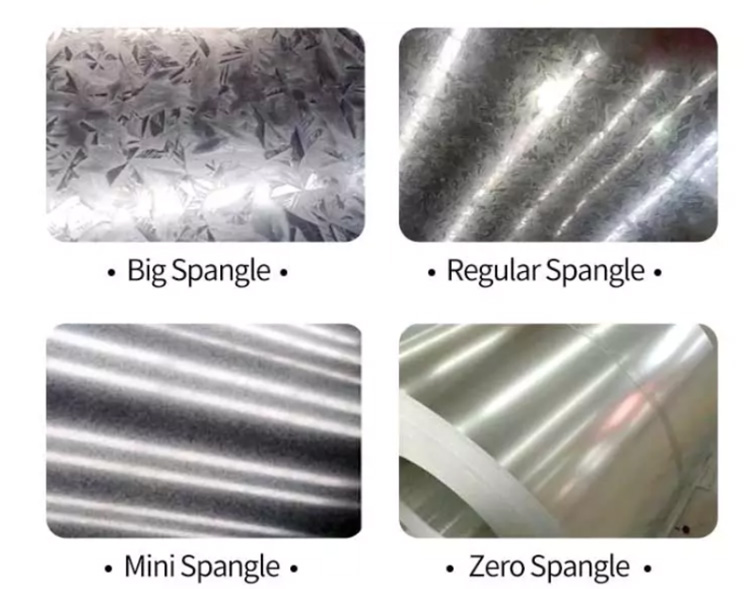
Zinc spangles are formed when the hot-dip galvanized coil cools and the zinc crystals precipitate out of the pattern. There is no good or bad distinction. Of course, the ones with zinc spangles are more suitable for beautiful surfaces and are suitable for guardrails; the ones without zinc spangles have a delicate surface and are suitable for spray painting and use in home appliances.
Spangle formation Spangle is a natural physical phenomenon of traditional hot-dip galvanizing. In the standard hot-dip galvanizing process, after the steel strip emerges from the zinc bath, the zinc liquid on the surface naturally solidifies and crystallizes, forming a crystal pattern resembling snowflakes or spiderwebs. This is spangle.
Spangle-free coatings utilize a special process to treat the zinc liquid before solidification, disrupting the normal growth of zinc crystals. This results in a uniform, smooth coating with no noticeable pattern.
Features
|
With spangles |
Without spangles |
|
Appearance
|
Distinct, slightly rough,
shiny crystal pattern |
Uniform and smooth |
Process
|
Zinc molten metal naturally
solidifies and crystallizes |
Zinc slag is used to inhibit crystal growth |
Surface
|
Microscopic bumps on the surface |
Smooth |
Corrosion Resistance
|
Grain boundaries are the
starting point of corrosion |
Uniform surface with
no grain boundaries |
Subsequent Processing
|
Surface unevenness affects paint film appearance and adhesion, and the passivation treatment results in uneven results. |
Provides a perfect base for spray painting, offering excellent paintability; the passivation treatment provides uniform results and strong resistance to white rust. |
Spangle-coated products do not require any decorative treatment, such as painting, and are used in buildings, factories, warehouses, and other applications where structural strength and basic rust protection are paramount, and appearance is less important.
Non-sparkle products require subsequent painting, printing, or lamination. They are suitable for appliances, furniture, cabinets, and other applications where aesthetics are paramount.


